Something Big Is Happening — And the Data Proves It
Matt Shumer's viral post shook 80 million people awake. Here's why the data backs him up, what history tells us about the skeptics, and what your business should actually do about it.
Last week, Matt Shumer published Something Big Is Happening, a 5,000-word piece aimed at his non-tech friends and family explaining what's really going on with AI. It hit 80 million views. It sparked a firestorm of reactions, rebuttals, and think-pieces.
And he's right. Not about everything. But about the thing that matters most.
The Shift Is Real
If you work in tech, you've felt it. Something changed in the last few months. The models didn't just get incrementally better. They crossed a threshold. Shumer describes it as the moment you realize "the water has been rising around you and is now at your chest."
I've experienced this firsthand. I'm the primary caregiver for my one-year-old son. I get maybe 3-4 productive hours a day between naps, feedings, and the general beautiful chaos of raising a toddler. And yet, in the last seven weeks, I've shipped more software than I did in all of 2025. Five active projects. 129 commits. A full SaaS platform, Cast Off, went from idea to feature-rich MVP with Stripe Connect, dynamic pricing, waivers, and a booking engine. In a matter of days, not months.
That's not hustle. That's a fundamental shift in what one person can accomplish.
Yes, Coding Is the Low-Hanging Fruit. Look at the Trajectory.
The most reasonable critique of Shumer's piece comes from Isaac Saul, who points out that code is structured, pattern-heavy, and therefore uniquely suited to AI. Journalism, law, medicine all have humanness that AI can't replicate. Can it build a relationship with a client? Read a jury? Know when to push a judge?
Fair. Today.
But here's what the skeptics aren't looking at: the trajectory.
METR's autonomous task completion research tells a story that should make every "AI isn't that good" critic pause. They measured how long AI agents can work autonomously, and it's been doubling every 7 months for the past 6 years. Consistently. Exponentially.
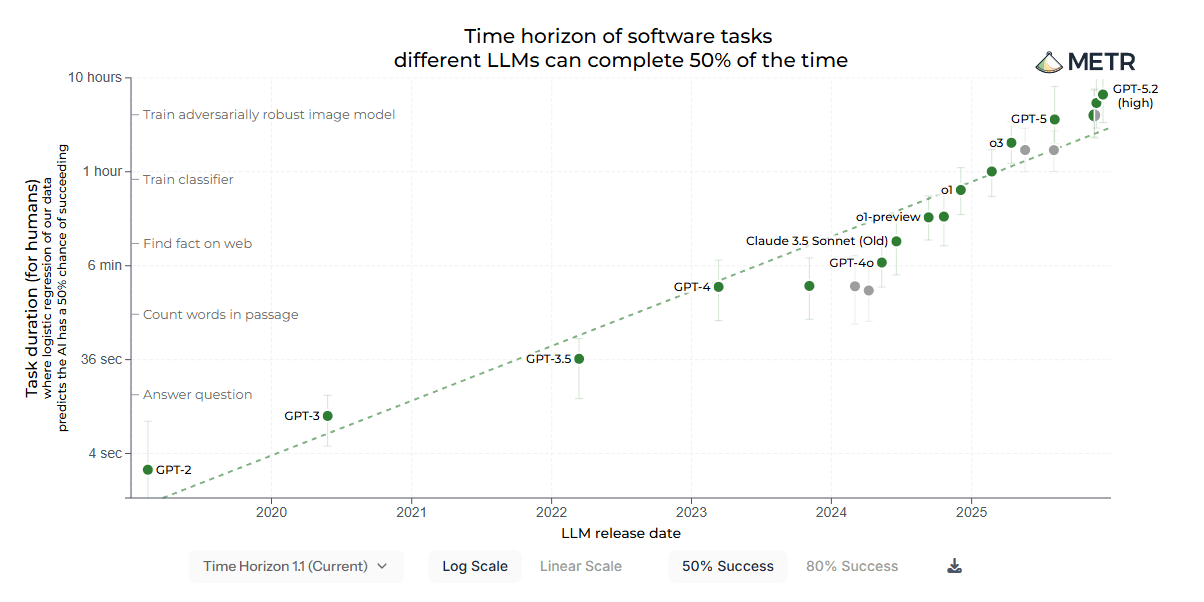
Today's frontier models reliably handle tasks that take humans up to a few minutes. They can sometimes handle tasks that take hours. If the trend continues for 2-4 more years, and there's no sign it's slowing, we're looking at agents that can independently complete work that currently takes humans weeks.
The critical insight: even if METR's measurements are off by a factor of 10x, that only shifts the timeline by about 2 years. The trend is that consistent.
So yes, coding was first. It won't be last.
The Asymmetry of Being Wrong
Here's the argument I keep coming back to, and it's the one I think every business leader needs to hear:
The cost of underestimating AI is catastrophically higher than the cost of overestimating it.
If you overestimate AI and start preparing now, the worst case is you invested some time learning tools that turned out to be ahead of their time. You built some muscle memory. You developed a point of view. No harm done.
If you underestimate it, dismiss it as hype, wait for "version 2," or assume your industry is somehow immune, and you're wrong? You wake up one morning and your competitor is doing in hours what takes your team weeks. You're not behind. You're irrelevant.
As Nathaniel Whittemore put it on the AI Daily Brief: the cost of underestimating is professional extinction. The cost of overestimating is some extra preparation time. The asymmetry is staggering.
The Seen and the Unseen
Connor Boyack wrote what I think is the most important response to the "AI is going to destroy jobs" panic. He invokes Frédéric Bastiat's 175-year-old insight: there is only one difference between a bad economist and a good one. The bad economist confines himself to the visible effect. The good economist takes into account both the effect that can be seen and those effects that must be foreseen.
When a new technology arrives, the seen effects are obvious and emotional. The assembly line worker whose job is automated. The copywriter watching AI produce in seconds what took her hours. These make for great headlines because fear drives engagement.
The unseen effects are, by definition, harder to see. But they're where the real story lives. The new industries that don't exist yet. The businesses that become possible because costs dropped. The solo founder who can now build what used to require a team of 20.
History is unambiguous on this:
- The knitting machine didn't ruin England. It made it the wealthiest nation on earth.
- The power loom didn't destroy textiles. It expanded the industry beyond imagination.
- The computer didn't end employment. It created the modern economy.
Every single time, the people who embraced the new tool and learned to work with it instead of against it came out ahead. The ones who clung to the old way got left behind. Not because the technology was unfair, but because they chose fear over curiosity.
Compounding Returns
Here's what I don't see enough people talking about: the returns from AI adoption compound.
The returns compound. AI helps you work faster, and the time you save gets reinvested into more work, which teaches you more about using AI effectively, which makes you faster still. Flywheel.
I'm living this. Seven weeks ago, I started building with an AI-native workflow. The first project took days. The next one took less. By the time I built Cast Off, I was describing features in plain English and reviewing finished implementations. Not because the AI got dramatically better in those seven weeks. Because I got better at working with it.
129 commits across 5 projects. As a part-time developer with a baby on his hip. That's not a story about AI capability. It's a story about what happens when a human leans in.
So What Should You Actually Do?
If you're a business leader reading this, here's my honest advice:
-
Stop waiting for permission. The "right time" to start was six months ago. The second-best time is today.
-
Start with your most painful workflow. Don't boil the ocean. Find the thing your team dreads: the repetitive analysis, the report generation, the data wrangling. See what AI can do with it this week.
-
Test one useful workflow. Pick something with a clear owner and a measurable result. A Focused AI Workflow Pilot is built for that. If it works, you have evidence for the next investment.
-
Build the adaptation muscle. Matt Shumer's best advice: "The people who come out of this well won't be the ones who mastered one tool. They'll be the ones who got comfortable with the pace of change itself."
The water is rising. You can stand there debating whether it's really that deep, or you can start swimming.
What are you waiting for?
Greg Mousseau is the founder of GTA Labs, an AI consulting firm that helps businesses build practical AI strategies and ship real solutions. He's been building with AI for 20 years and is currently shipping more code than ever, with a one-year-old on his hip.