How to Automate Legacy Software Without Replacing It
62% of enterprises still run legacy software and half of RPA projects fail to scale. There's a better approach: let AI agents explore your legacy UI, then ship deterministic automation that runs forever.
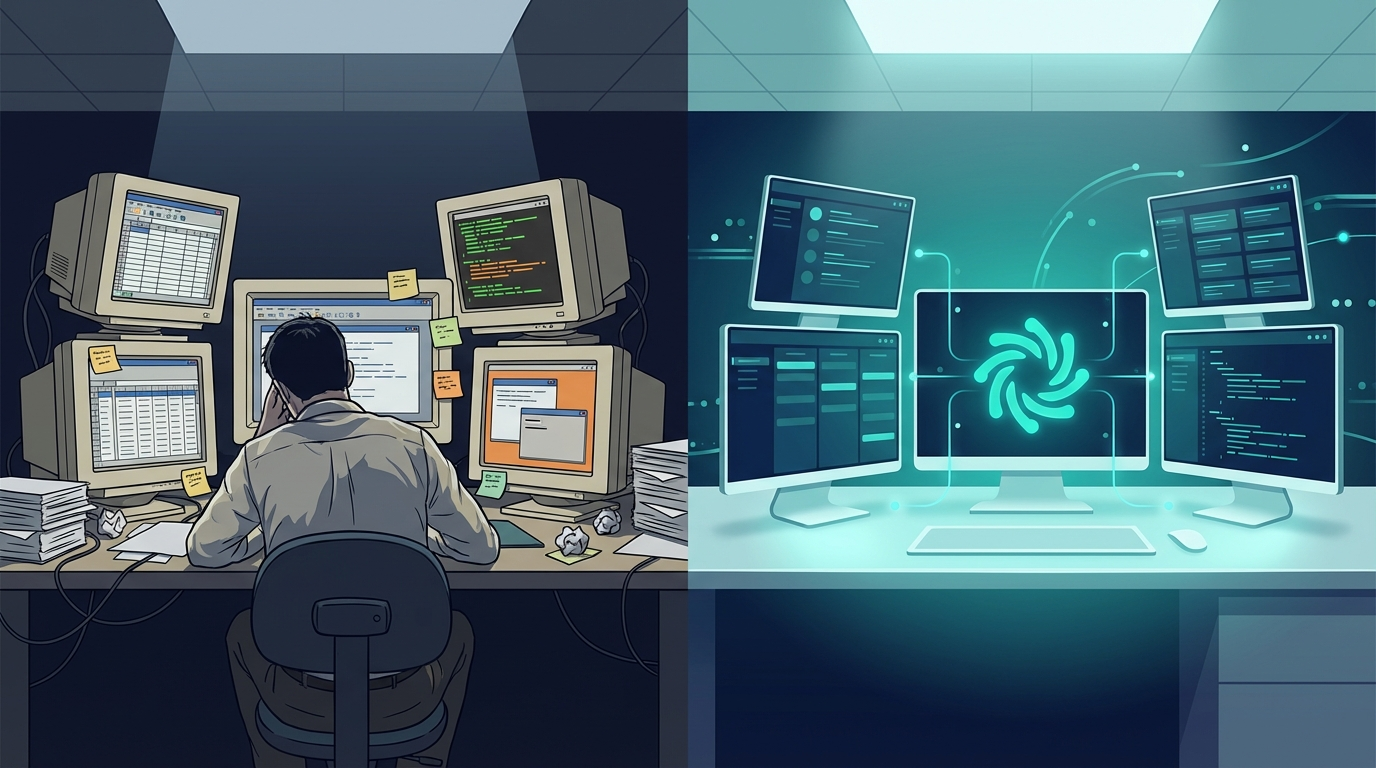
TL;DR: AI for discovery, scripts for production.
Someone on your team spent three hours today copying data between two systems that don't talk to each other. They tabbed between a browser window from 2008 and a spreadsheet, squinting at field labels that haven't been updated since the Obama administration. They did this yesterday too. They'll do it again tomorrow.
You know this is happening. You've known for years. And you've probably tried to fix it at least once.
So why is it still happening?
The Legacy Trap
Here's the uncomfortable math: 62% of organizations still run on legacy software (Saritasa, 2025). Not because they're lazy. Because the software works. It holds decades of business logic, customer data, institutional knowledge. Ripping it out would cost millions and take years. The migration project that was supposed to fix everything? It's on its third project manager and second vendor.
So people cope. They hire more staff. They build workarounds in Excel. They paste data between systems manually because "that's just how we do it."
The cost isn't abstract. Parseur estimates that manual data entry burns $28,500 per employee per year. Smartsheet found that over 40% of workers spend more than a quarter of their week on manual, repetitive tasks. That's not a rounding error. That's a full day per week, per person, spent on work a machine should be doing.
This problem is everywhere. 70% of banks still run on legacy systems. More than 60% of hospitals do too. The federal government spends $337 million per year maintaining just ten critical legacy systems. These aren't edge cases. This is the norm.
Why RPA Didn't Fix It
Robotic Process Automation (RPA) was supposed to be the answer. UiPath, Automation Anywhere, Blue Prism. The pitch was compelling: record what your employee does, play it back as a bot.
Companies bought in hard. And then reality hit.
Gartner found that 50% of RPA projects fail to scale past the pilot phase. Half. Think about that. Companies spend months on proof-of-concept, declare victory, then watch the whole thing collapse when they try to roll it out to real workflows.
The reason is structural, not tactical. Traditional RPA bots are pixel-perfect scripts. They click on exact coordinates. They match exact screen layouts. They follow rigid decision trees that a developer hard-coded months ago.
Then someone updates the UI. A button moves three pixels. A dropdown gets an extra option. A pop-up appears that wasn't there during development. The bot crashes. A ticket gets filed. An RPA developer spends a day fixing it. Multiply this across dozens of bots and you start to understand why exception handling eats 35-60% of RPA maintenance budgets.
The economics don't help either. Traditional RPA licenses run $10,000 to $66,000+ per bot per year. That's before you pay for the developers to build, maintain, and babysit them. For large enterprises with deep pockets, maybe that pencils out. For a mid-market company running three legacy systems with a lean IT team? It's a non-starter.
RPA vendors will tell you the technology has matured. And it has, in the same way that a faster horse is still a horse. The fundamental architecture is brittle by design. It automates the happy path and falls apart the moment reality gets messy.
A Different Approach: AI Agents That Actually See the Screen
What if, instead of scripting every click in advance, you let an AI agent sit in front of the legacy system and figure it out the way a new employee would?
That's not a hypothetical. It's what we do at GTA Labs.
Here's how it works in practice.
Step 1: The AI explores. We point an AI agent (think Claude Computer Use, browser automation tools, computer vision) at your legacy system. The agent navigates the interface, reads labels, identifies fields, maps out workflows. It's not following a script. It's understanding the application.
Step 2: The AI learns the workflow. We define what needs to happen: "Take this lead from the CRM, enter it into the property management system, update the status field, attach the document." The agent works through the process, handling the quirks. The weird pop-up that appears on Tuesdays. The dropdown that loads slowly. The confirmation dialog that sometimes shows up twice.
Step 3: We generate deterministic scripts. This is the part most people miss, and it's the most important part. The AI doesn't run your automation forever. Once it understands the workflow, we extract that knowledge into clean, deterministic automation scripts. No AI inference at runtime. No API costs per execution. No wondering if the model will hallucinate a wrong click. Just reliable, repeatable automation.
The principle: AI for discovery, scripts for production.
This distinction matters. Companies are rightly nervous about putting AI in the loop for critical business processes. "What if the model makes a mistake?" is a fair question. Our answer: the model isn't in the loop at production time. It did the hard work of understanding your chaotic legacy UI. The automation that actually runs every day is deterministic code.
Why This Beats Traditional RPA
Traditional RPA breaks when the UI changes. AI agents adapt.
An RPA bot looking for a button labeled "Submit" at coordinates (450, 320) will fail if that button moves. An AI agent looking for a submit button on a form will find it whether it's at the top, the bottom, or hidden behind a tab. It reads the screen the way you do.
This resilience compounds over time. When your legacy vendor pushes an update (yes, even legacy vendors push updates occasionally), an RPA bot needs a developer to fix it. An AI agent can re-learn the new layout and regenerate the automation scripts. The maintenance cost drops dramatically.
The economics are different too. The agentic AI market hit $28 billion in 2024 and is projected to reach $127 billion by 2029. That growth is driven by real results, not hype. Companies are discovering that AI agents can do in days what RPA projects take months to deliver, at a fraction of the licensing cost.
What This Looks Like in Practice
We recently automated lead management for a mid-sized real estate brokerage stuck on a legacy property management system. Their managing broker was spending 2.5 hours every morning manually clicking through listings, filtering by criteria, and routing leads to a team of thirty agents. The platform had no API, no webhooks, no export functionality.
We built a monitoring layer that polls the legacy system automatically, filters against configurable criteria, and routes leads into a clean two-section dashboard: sales claims and rental approvals. The broker went from three hours of clicking to twelve minutes of reviewing.
Over a month, that's roughly fifty hours returned to someone who was spending them on work a machine could handle. Response times dropped. Routing errors disappeared. Agents got assignments earlier and closed more deals.
The ROI wasn't complicated to calculate. The automation paid for itself in weeks, not months. But the real win wasn't the time savings. It was what the team did with those reclaimed hours.
What This Means for Your Business
If you're running legacy software, you probably fall into one of three camps:
Camp 1: You've tried RPA and it didn't stick. You spent six figures on licenses and consulting, got a few bots working, and then watched them break every time something changed. You're not alone. Half of all RPA projects end up here.
Camp 2: You've been quoted on RPA and the numbers didn't make sense. For mid-market companies, traditional RPA pricing is often absurd relative to the problem it solves. You shouldn't need to spend $50K/year to automate a data entry task.
Camp 3: You've just been living with it. Your team manually bridges the gaps between systems because that's how it's always been done. You know it's inefficient. You just haven't found a solution that's worth the disruption.
All three camps have the same underlying problem: the automation tools available until now weren't designed for messy, real-world legacy software. They were designed for clean, well-documented systems with stable interfaces. That's not what you have.
AI agents change the equation. They work with your systems as they actually are, not as they were supposed to be. They handle the edge cases, the weird UI quirks, the undocumented workflows that only Janet in accounting knows about. And the output isn't a black-box AI that you have to trust and pray. It's deterministic automation that you can inspect, test, and rely on.
Stop Paying the Legacy Tax
Every day your team spends on manual workarounds is a day you're paying the legacy tax. Not because your software is old, but because nobody's built the right bridge between what you have and what you need.
That's what we do at GTA Labs. We use AI agents to understand your legacy systems, map your workflows, and build automation that actually holds up in production. No multi-year migration projects. No six-figure RPA licenses. Just working automation, delivered in weeks.
If your team is burning hours on manual processes that a computer should handle, let's talk. We'll show you exactly what's possible.